

Explore our Line of Home Hospital Beds
Advanced Beds
Wholesale Pricing Available for Healthcare Facilities & Government Agencies Call 310-817-5373 for Commercial Quotes & Bulk Purchasing
Advanced Rotation Beds by Med-Mizer (Excellent for Getting in and out of bed, with Independence and Rehab)

Advanced Care System Packages
(Excellent for both Facilities and Homes who want a Complete Integrated Setup )


Advanced Fall Risk Beds
(Great for Preventing Falls)


Bed Guide
Comparison Guide (Choose the right Bed)
Though the Advanced LTC beds and Smart Beds have better features and power overall. The right choice depends on the person's mobility, fall risk, caregiver needs, expected length of use, positioning requirements, and overall level of care a person wants in their recovery.
A standard insurance-style semi-electric hospital bed is designed to provide basic medical bed functionality. An Advanced Long-Term Care Bed is designed for people who need a higher level of safety, positioning, accessibility, comfort, and caregiver support.
When a Semi-Electric Hospital Bed May Be Enough
A semi-electric hospital bed can be an appropriate choice when the patient's needs are minimal, ideally for someone with most of their mobility.
These beds typically provide powered adjustment of the head and knee/leg sections, while bed height is adjusted manually with a crank.
A semi-electric bed may be appropriate for someone who:
-
Needs to sleep with their head elevated.
-
Needs basic leg positioning.
-
Spends only part of the day in bed.
-
Has relatively good mobility.
-
Can transfer with minimal assistance.
-
Has a caregiver who can safely work with the bed's fixed or manually adjusted height.
-
Needs the bed temporarily during recovery.
-
Does not have significant fall-risk or advanced positioning requirements.
-
Primarily needs a basic hospital bed that may qualify under an insurance benefit.
Example Use Case
A patient is discharged home after surgery and needs a hospital bed for several weeks while recovering. The patient can still stand, walk with assistance, and reposition reasonably well.
In this situation, a semi-electric bed may provide everything the patient needs without requiring a more advanced bed system.
When an Advanced Long-Term Care Bed Is Better
An Advanced Long-Term Care Bed becomes much more valuable when the bed is going to function as an actual care platform or the Person wants a system to streamline the recovery process.
Depending on the specific model, these beds can provide features such as:
-
Fully powered height adjustment
-
Much lower sleeping positions
-
Greater caregiver working height
-
Head and knee articulation
-
Trendelenburg and Reverse Trendelenburg positioning
-
Advanced chair or contour positioning
-
Greater weight capacities
-
Wider sleeping surfaces
-
More substantial side-assist devices
-
Advanced pressure-relief mattress compatibility
-
Easier caregiver access
-
More home-like designs
-
Additional positioning and safety features
These features become increasingly important as a person's mobility or medical needs become more complex.
Use Case #1 — High Fall Risk
Imagine an older adult who frequently attempts to get out of bed without assistance.
A traditional hospital bed may remain relatively high from the floor. An Advanced Long-Term Care Bed can often lower much closer to the floor.
That difference can be extremely important.
Instead of relying exclusively on side rails to address fall risk, caregivers can create a lower sleeping environment that may help reduce the potential severity of a fall.
For a person with dementia, weakness, poor balance, or a history of falls, low-bed capability can be one of the most important reasons to move beyond a traditional semi-electric bed.
Use Case #2 — Heavy Caregiver Involvement
Consider a patient who requires assistance with:
-
Dressing
-
Brief changes
-
Repositioning
-
Wound care
-
Transfers
-
Bathing
-
Daily personal care
Bed height suddenly becomes extremely important.
With an Advanced Long-Term Care Bed, the caregiver can raise the entire mattress platform to a more appropriate working height and lower it again when care is completed.
That can make everyday care significantly easier than repeatedly bending over a lower bed.
For someone receiving extensive care every day, the bed isn't only for the patient — it is also a workstation for the caregiver.
Use Case #3 — Long-Term Home Care
Suppose someone initially needs only moderate assistance but is expected to remain in the bed for several years.
A basic semi-electric bed might meet today's needs.
The question becomes:
Will it meet the person's needs six months, two years, or five years from now?
An Advanced Long-Term Care Bed can provide greater flexibility as mobility changes and caregiving requirements increase.
This is why families caring for someone with a progressive condition or long-term mobility limitations may choose an advanced bed before every advanced feature is immediately necessary.
Use Case #4 — Pressure Injury Risk
The mattress is ultimately the primary pressure-management surface, but the bed underneath it also matters.
A patient who spends substantial amounts of time in bed may eventually require:
-
High-specification pressure redistribution foam
-
Alternating-pressure therapy
-
Low-air-loss therapy
-
Advanced positioning
-
More frequent caregiver repositioning
An Advanced Long-Term Care Bed can serve as a stronger foundation for building a more comprehensive pressure-management system.
For patients with significant pressure-injury risk or existing wounds, the appropriate mattress should always be selected based on the patient's clinical needs and healthcare team's recommendations.
Use Case #5 — Difficult Transfers
A patient may be able to stand but struggle getting from the mattress into a walker or wheelchair.
An advanced bed's powered height adjustment allows the mattress surface to be positioned at a more useful transfer height.
The caregiver can potentially bring the patient higher before standing or lower the bed to better match a wheelchair or other transfer surface.
For patients whose biggest challenge is getting into and out of bed, this can be considerably more useful than basic head-and-foot articulation alone.
The Biggest Difference Is the Level of Care
Think about the two categories this way:
Semi-Electric Hospital Bed = Basic Medical Support
It is designed to provide essential hospital-bed functionality at an economical price and can be perfectly appropriate for patients with relatively straightforward needs.
Advanced Long-Term Care Bed = Advanced Care Environment
It is designed around long-term use, changing mobility, caregiver access, positioning, fall-risk management, comfort, and more complex care.
The advanced bed doesn't necessarily mean the patient is "sicker." It means the equipment provides more tools to manage their care.
Which One Should You Choose?
Choose a Semi-Electric Hospital Bed when the person primarily needs basic head and leg positioning, has relatively good mobility, requires limited caregiver assistance, and does not need advanced height, positioning, or fall-management features.
Consider an Advanced Long-Term Care Bed when the person has significant mobility limitations, requires frequent caregiver assistance, is at increased fall risk, spends substantial time in bed, needs advanced positioning, has difficult transfers, or is expected to require the bed for long-term care.
-
What Is the Difference Between a Smart Bed and an Advanced Long-Term Care Bed?
A Smart Bed and an Advanced Long-Term Care Bed can both provide sophisticated positioning, safety, and caregiver features, but they are designed around different levels and environments of care.
The easiest way to understand the difference is:
Advanced Long-Term Care Bed = Advanced positioning, safety, comfort, and caregiver support.
Smart Bed = Advanced care features PLUS integrated technology that can monitor, measure, alert, or provide caregivers with additional patient information.
In other words, not every Advanced Long-Term Care Bed is a Smart Bed, but many Smart Beds incorporate features normally found on Advanced Long-Term Care Beds.
What Is an Advanced Long-Term Care Bed?
An Advanced Long-Term Care Bed is designed for patients who require more support than a traditional semi-electric or basic full-electric hospital bed can provide.
Depending on the model, an Advanced Long-Term Care Bed may include:
-
Full electric height adjustment
-
Ultra-low positioning
-
Head and knee articulation
-
Trendelenburg and Reverse Trendelenburg
-
Chair and contour positioning
-
Advanced side-assist devices
-
Central locking casters
-
Higher weight capacities
-
Wider sleeping surfaces
-
Advanced mattress compatibility
-
Transfer-friendly positioning
-
Caregiver-friendly working heights
-
Home-like or residential styling
These beds are commonly appropriate for advanced home care, assisted living, memory care, hospice, skilled nursing, rehabilitation, and other long-term care environments.
Their primary purpose is to make positioning, transfers, caregiving, comfort, and safety easier to manage.
What Makes a Bed a "Smart Bed"?
A Smart Bed goes beyond powered movement.
It incorporates electronic monitoring, sensing, alerts, measurement, or other integrated technologies designed to give caregivers more information about the patient or the status of the bed.
Depending on the specific Smart Bed, features may include:
-
Integrated patient weight scales
-
Bed-exit alarms
-
Multiple bed-exit sensitivity zones
-
Patient-position monitoring
-
Brake-status indicators
-
Bed-height indicators
-
Head-of-bed angle indicators
-
Caregiver control panels
-
Position memory
-
Integrated USB or electrical outlets
-
Audible or visual safety alerts
-
Advanced diagnostic or status displays
Higher-end institutional Smart Beds may go even further by connecting with nurse-call systems, electronic medical records, hospital networks, patient-monitoring platforms, or centralized clinical systems.
The exact capabilities vary significantly by manufacturer and model.
Use Case #1 — Long-Term Home Care Without Advanced Monitoring
Consider an older adult living at home who has limited mobility and needs considerable assistance from family or caregivers.
The family needs:
-
A very low sleeping position
-
Powered height adjustment
-
Easier transfers
-
Advanced positioning
-
Better caregiver access
-
Pressure-relief mattress compatibility
However, they don't necessarily need an integrated scale or sophisticated bed-exit monitoring.
An Advanced Long-Term Care Bed may be the better value because it provides the physical capabilities the family actually needs without paying for technology they may rarely use.
Use Case #2 — High Fall Risk and Unassisted Bed Exit
Now consider a patient with cognitive impairment who frequently attempts to get out of bed without assistance.
An Advanced Long-Term Care Bed can address part of the problem through ultra-low positioning and appropriate assist devices.
A Smart Bed can potentially add another layer of information through a bed-exit monitoring system.
Depending on the system, the bed may detect changes in the patient's position or when the patient begins leaving the bed and provide an alert to the caregiver.
The Smart Bed doesn't replace supervision or appropriate fall-prevention practices, but its monitoring capabilities can provide caregivers with additional information.
Use Case #3 — Monitoring Patient Weight
Imagine a patient whose healthcare team wants their weight monitored regularly.
With a traditional Advanced Long-Term Care Bed, caregivers may need to transfer the patient onto a separate scale or use other weighing equipment.
A Smart Bed equipped with an integrated scale may allow the patient to be weighed while remaining in bed.
For patients with severe mobility limitations, this can be a significant convenience.
Use Case #4 — Assisted Living or Skilled Nursing
In a care facility, staff may be responsible for many residents simultaneously.
An Advanced Long-Term Care Bed provides the physical tools necessary to safely position and care for the resident.
A Smart Bed may provide additional information such as:
Is the bed at its lowest position?
Are the brakes engaged?
Is the patient attempting to leave the bed?
What is the patient's current weight?
What position is the bed currently in?
These capabilities can make Smart Beds particularly valuable in environments where caregivers are managing multiple patients.
Use Case #5 — Complex Home Care
Smart Bed technology is no longer limited exclusively to large hospitals.
Some advanced home-care beds now incorporate technologies previously associated primarily with institutional hospital beds.
For example, a family caring for a medically complex patient at home may benefit from a bed that combines:
-
Advanced positioning
-
Ultra-low height
-
Integrated weighing
-
Bed-exit monitoring
-
Central locking
-
Caregiver controls
-
Advanced pressure-relief surfaces
In this situation, the Smart Bed effectively becomes a home-care platform, bringing some institutional-style capabilities into the home.
Is a Smart Bed Automatically Better?
No.
This is one of the most important distinctions.
A Smart Bed with numerous electronic features is not automatically the best bed for every patient.
The question should be:
Does the patient actually benefit from those technologies?
For one patient, an integrated scale and bed-exit alarm could be extremely valuable.
For another patient, the priorities may simply be:
-
Getting extremely low to the floor
-
Raising high enough for caregiver care
-
Comfortable positioning
-
Easier transfers
-
Accommodating an advanced therapeutic mattress
That person may receive greater value from a high-quality Advanced Long-Term Care Bed without extensive smart technology.
What About Smart Beds With Rotation?
There is another level beyond conventional Smart Beds: advanced rotation and transfer-assist beds.
These systems may physically rotate the patient toward the side of the bed and transition the sleeping surface toward a seated position.
For someone who struggles significantly with getting into or out of bed, powered rotation can address a completely different problem than an integrated scale or electronic monitoring system.
This is why bed selection should not simply be:
Basic Bed → Advanced Bed → Smart Bed
Instead, think of advanced beds as different tools for different care problems.
A patient might benefit more from a Rotation Bed than a Smart Bed.
Another patient might benefit more from a Smart Bed with an integrated scale and bed-exit monitoring.
Another may simply need a high-quality Advanced Long-Term Care Bed with excellent low-height and positioning capabilities.
Advanced Long-Term Care Bed vs. Smart Bed
CapabilityAdvanced Long-Term Care BedSmart Bed
Full Electric AdjustmentTypically YesTypically Yes
Advanced Hi-LowOftenOften
Head & Knee PositioningYesYes
Trendelenburg / Reverse TrendelenburgModel DependentOften Available
Chair/Contour PositioningModel DependentOften Available
Advanced Mattress CompatibilityYesYes
Integrated Patient ScaleUsually NotMay Be Available
Bed-Exit MonitoringBasic/Model DependentOften Available
Electronic Safety IndicatorsLimited/Model DependentCommon on Higher-End Systems
Patient Monitoring TechnologyUsually LimitedPrimary Differentiator
Powered RotationOnly Specialized ModelsOnly Specialized Models
Best ApplicationAdvanced Daily CareAdvanced Care + Monitoring
Features vary by manufacturer and model.
Which Bed Should You Choose?
Consider an Advanced Long-Term Care Bed when the primary concerns are:
Positioning + transfers + fall-risk management + caregiver access + comfort + long-term care.
Consider a Smart Bed when the patient needs those advanced capabilities but would also benefit from:
Monitoring + alerts + integrated measurements + additional caregiver information.
Consider a Rotation Bed when one of the biggest challenges is:
Physically getting the patient from lying in bed into a seated transfer position.
Bottom Line
The biggest difference isn't simply how many motors the bed has.
An Advanced Long-Term Care Bed manages the patient's physical care environment.
A Smart Bed adds technology that can help monitor the patient, the bed, or both.
The best bed is the one that solves the patient's actual care problems.
For someone who primarily needs safer positioning, easier transfers, lower bed height, and caregiver accessibility, an Advanced Long-Term Care Bed may be all they need.
For someone whose care plan would also benefit from integrated weight measurement, bed-exit alerts, safety indicators, or other monitoring technologies, a Smart Bed may provide a meaningful additional level of support.
-
How Does a Smart Hospital Bed Differ From a Lifestyle Adjustable Bed?
A premium Lifestyle Adjustable Bed and a Custom Smart Hospital Bed can both provide exceptional comfort, powered positioning, and a luxury sleeping experience. The major difference is how far the bed can go beyond comfort when healthcare needs arise.
The easiest way to understand the difference is:
Lifestyle Adjustable Bed = Maximum comfort, sleep, relaxation, and lifestyle features.
Custom Smart Hospital Bed = Maximum comfort combined with maximum healthcare capability, safety, mobility support, positioning, and caregiver functionality.
A Custom Smart Hospital Bed is not designed to make a patient choose between comfort and medical care. Its purpose is to bring the two together.
What Is a Lifestyle Adjustable Bed?
A premium Lifestyle Adjustable Bed is primarily engineered around the sleeping experience.
Depending on the system, it may include:
-
Premium foam, hybrid, or adjustable-air mattresses
-
Powered head and leg positioning
-
Zero-gravity positioning
-
Massage
-
Adjustable firmness
-
Heating or cooling technology
-
Sleep tracking
-
Position memory
-
App-based controls
-
Premium residential styling
For an independent individual whose primary concern is achieving a luxurious and highly adjustable sleeping environment, these systems can be excellent.
However, their primary engineering purpose remains sleep and lifestyle comfort.
What Is a Custom Smart Hospital Bed?
A Custom Smart Hospital Bed takes the concept much further.
It can be configured to provide a premium sleeping and comfort environment while simultaneously functioning as an advanced healthcare platform.
Depending on the bed and configuration, that can include:
Premium Comfort
-
Premium pressure-redistribution mattresses
-
Advanced foam systems
-
Low-air-loss surfaces
-
Alternating-pressure surfaces
-
Wider sleeping surfaces
-
Customized mattress options
-
Advanced contour positioning
-
Chair positioning
-
Personalized positioning
-
Residential-style finishes
Advanced Healthcare
-
Full powered height adjustment
-
Ultra-low positioning
-
Advanced head and knee articulation
-
Trendelenburg and Reverse Trendelenburg
-
Integrated patient weighing
-
Bed-exit monitoring
-
Caregiver controls
-
Patient-control lockouts
-
Central locking
-
Advanced transfer positioning
-
Pressure-management surfaces
-
Higher weight capacities
-
Expandable sleep decks on certain systems
-
Emergency and caregiver functions
-
Additional monitoring and safety technologies
Features vary by the specific bed and configuration.
The objective is therefore not simply to create a more sophisticated hospital bed.
It is to create a complete sleep-and-care environment around the individual.
The Important Difference: Comfort PLUS Healthcare
This is where Custom Smart Hospital Beds should be distinguished from both traditional hospital beds and Lifestyle Adjustable Beds.
A traditional medical bed may focus heavily on healthcare functionality.
A Lifestyle Adjustable Bed may focus heavily on comfort.
A properly configured Custom Smart Hospital Bed can bring both sides together.
Think of it as:
Luxury Lifestyle Bed
Comfort ★★★★★
Healthcare Capability ★★Traditional Hospital Bed
Comfort ★★–★★★
Healthcare Capability ★★★Custom Smart Hospital Bed
Comfort ★★★★★
Healthcare Capability ★★★★★The goal is to provide the comfort someone would expect from a premium residential sleep system while adding the capabilities required for advanced healthcare.
Example: The Independent User
Consider someone who wants an extremely comfortable premium bed but also has developing mobility concerns.
Today, that individual may primarily care about:
-
Mattress comfort
-
Width
-
Head elevation
-
Leg elevation
-
Contour positioning
-
Ease of getting into bed
A Lifestyle Adjustable Bed may handle many of those requirements.
But what happens if that person's care requirements increase?
They may eventually need:
-
Greater transfer assistance
-
Whole-bed height adjustment
-
A lower sleeping position
-
Caregiver access
-
Pressure management
-
Bed-exit monitoring
-
An integrated scale
-
More sophisticated positioning
A Custom Smart Hospital Bed can potentially provide those capabilities without requiring the individual to give up the premium sleeping environment they wanted in the first place.
Example: Advanced Home Care
Consider someone receiving extensive care at home.
They spend significant time in bed and require caregiver assistance throughout the day.
Comfort becomes more important, not less important, because the individual may spend far more time in bed than the average person.
At the same time, caregivers may need:
-
Appropriate working height
-
Advanced positioning
-
Easier transfers
-
Pressure-management options
-
Patient monitoring
-
Fall-risk management features
This is exactly where a Custom Smart Hospital Bed can excel.
The patient receives a system designed around comfort and quality of life, while caregivers receive a system designed around providing care.
Why Mattress Selection Matters
A major advantage of an advanced medical sleep system is that comfort can be customized around the patient's actual needs.
Someone may benefit from a premium pressure-redistribution foam mattress.
Another individual may require alternating-pressure therapy.
Another may benefit from low-air-loss technology.
Another may simply want a wider, premium medical-grade sleep surface with advanced positioning.
Therefore, the mattress and the bed should be viewed as a complete system rather than separate products.
The frame provides positioning, mobility, safety, and caregiver functionality.
The mattress provides the appropriate combination of comfort, support, and pressure management.
Smart Hospital Bed vs. Lifestyle Adjustable Bed
CapabilityLifestyle Adjustable BedCustom Smart Hospital Bed
Premium Comfort★★★★★★★★★★
Head & Leg Positioning✓✓
Premium Mattress Options✓✓
Zero-Gravity/Contour Positions✓✓
Whole-Bed Height AdjustmentLimited/Usually No✓
Ultra-Low PositioningUsually No✓
Advanced Transfer SupportLimited✓
Caregiver Working HeightNo✓
Integrated ScaleUsually NoAvailable
Bed-Exit MonitoringUsually NoAvailable
Advanced Pressure ManagementLimited✓
Low-Air-Loss/Alternating PressureNot Primary PurposeAvailable
Caregiver ControlsNo✓
Medical Safety FeaturesLimited✓
Advanced Clinical PositioningLimited✓
Long-Term Complex CareNot Primary Purpose✓
Luxury/Residential Experience✓✓
Primary GoalPremium SleepPremium Sleep + Advanced Care
Exact features depend on the specific model and configuration.
Which One Is Better?
The answer depends on what the individual needs.
If someone is healthy, independent, and primarily wants an exceptional sleeping experience, a premium Lifestyle Adjustable Bed may be the appropriate choice.
But if someone wants that same emphasis on comfort while also needing advanced healthcare capabilities, a Custom Smart Hospital Bed can provide a much broader solution.
That is the fundamental difference.
A Custom Smart Hospital Bed isn't simply:
"A hospital bed with more technology."
It is better understood as:
A premium personalized sleep system engineered around both comfort and healthcare.
Bottom Line
A Lifestyle Adjustable Bed asks:
"How can we make your sleep more comfortable?"
A Custom Smart Hospital Bed asks:
"How can we make you as comfortable as possible while also providing the highest level of care, safety, positioning, mobility support, and caregiver functionality your situation requires?"
For people with complex or changing care needs, that combination is what separates a Custom Smart Hospital Bed from a conventional Lifestyle Adjustable Bed.
You don't have to choose between comfort and care. The right Custom Smart Hospital Bed is designed to provide both.
-
What Is a Fall Risk Bed and How Does It Benefit?
A Fall Risk Bed, sometimes called a Low Bed or Ultra-Low Hospital Bed, is a medical bed specifically designed for individuals who are at increased risk of falling when getting into, getting out of, or moving around their bed.
Unlike a traditional hospital bed, which may remain relatively high from the floor, a Fall Risk Bed can lower the entire sleeping surface much closer to the ground.
Depending on the model, advanced Fall Risk Beds may also provide:
-
Ultra-low height adjustment
-
Full electric hi-low operation
-
Advanced side-assist devices
-
Bed-exit alarms
-
Patient-position monitoring
-
Floor-level safety lighting
-
Central locking casters
-
Caregiver controls
-
Patient-control lockouts
-
Transfer positioning
-
Trendelenburg and Reverse Trendelenburg
-
Chair or contour positioning
-
Advanced pressure-relief mattress compatibility
The goal is not simply to make the bed lower.
The goal is to create a safer environment for someone whose mobility, balance, strength, cognition, or judgment makes getting into or out of bed more difficult.
Why Does Bed Height Matter?
One of the most important features of a Fall Risk Bed is its ability to lower closer to the floor.
Consider someone sleeping several feet above the floor. If that person rolls out of bed or attempts to stand and loses their balance, the height of the sleeping surface can contribute to the severity of the fall.
A low or ultra-low bed reduces that vertical distance.
When appropriate, caregivers may also use compatible floor mats and other fall-risk interventions around the bed.
A Fall Risk Bed does not eliminate the possibility of falling, but lowering the sleeping surface can be an important part of a broader fall-risk management strategy.
Who May Benefit From a Fall Risk Bed?
Fall Risk Beds can be useful for individuals experiencing:
-
Weakness
-
Poor balance
-
Limited mobility
-
Difficulty standing
-
Frequent nighttime movement
-
Cognitive impairment
-
Confusion
-
History of falls
-
Difficulty transferring
-
Progressive mobility decline
-
Recovery after hospitalization or surgery
-
Neurological or age-related mobility limitations
They can be used in private homes as well as assisted living, memory care, rehabilitation, skilled nursing, hospice, and other care environments.
Use Case #1 — The Patient Who Tries to Get Up Alone
Consider an older adult who has enough strength to attempt standing but does not have enough balance to safely walk without assistance.
During the night, the individual wakes up and attempts to get out of bed without calling the caregiver.
With a traditional bed, the person may have to slide down from a relatively high mattress surface before their feet securely reach the floor.
A Fall Risk Bed can be lowered to a more appropriate height.
This does not guarantee a safe transfer, but it can create a more manageable environment for someone who may attempt to stand unexpectedly.
Use Case #2 — Dementia or Cognitive Impairment
Fall risk isn't always caused by physical weakness.
Sometimes the person has enough physical ability to get out of bed but does not recognize their limitations.
For example, someone experiencing cognitive impairment may forget that they need assistance.
An advanced Fall Risk Bed may combine ultra-low positioning with bed-exit monitoring.
Depending on the system, an alarm may notify a caregiver when movement consistent with an attempted bed exit is detected.
This creates two different layers of support:
Low Position = Physical risk-management strategy
Bed-Exit Monitoring = Caregiver awareness strategy
The alarm does not physically prevent a fall, but it may provide caregivers with useful information so they can respond.
Use Case #3 — Difficult Transfers
Fall-risk management isn't only about someone falling out of bed.
Transfers can also be a high-risk moment.
If the mattress is too high, a shorter individual may struggle to place their feet firmly on the floor.
If it is too low, someone with weak legs may have difficulty standing.
A powered hi-low bed allows caregivers to adjust the height based on the activity being performed.
For example, the bed may be lowered for sleeping and then raised to a more appropriate transfer height when the person is preparing to stand.
This is one of the major advantages of a true medical hi-low bed.
Use Case #4 — Caregiver Assistance
Consider someone who requires assistance with:
-
Dressing
-
Repositioning
-
Brief changes
-
Bathing
-
Wound care
-
Transfers
-
Daily personal care
The lowest possible bed position isn't necessarily the best position while providing care.
The caregiver may need the bed significantly higher.
A Fall Risk Bed with powered hi-low adjustment can provide two very different working environments from the same bed:
LOW for the patient's resting environment
and
HIGH for caregiver access and certain transfers.
Once care is completed, the bed can be returned to its appropriate low position.
Use Case #5 — Someone Returning Home After a Fall
Imagine an older adult who was hospitalized after a fall and is now returning home.
Before the accident, they slept in a traditional residential bed.
After discharge, the family realizes that:
-
Mobility has decreased.
-
Standing is more difficult.
-
Balance is poor.
-
Nighttime bathroom trips are concerning.
-
Family members now assist with transfers.
The family's bed requirements have changed.
Instead of simply asking:
"What mattress is comfortable?"
they now need to ask:
"What sleeping environment best supports this person's current mobility and care needs?"
A Fall Risk Bed may become an important component of that environment.
Why Not Just Use Side Rails?
Side rails and assist devices can be useful when appropriately selected, but side rails should not automatically be considered the solution to fall risk.
Depending on the individual and the type of rail, inappropriate use can create additional risks, including entrapment or attempts to climb over the rail.
For some individuals, the better strategy may involve a combination of:
-
Low bed positioning
-
Appropriate assist devices
-
Floor mats
-
Clear pathways
-
Proper lighting
-
Mobility aids
-
Bed-exit monitoring
-
Caregiver supervision
-
Individualized clinical recommendations
Fall prevention should be based on the person's specific condition and care plan rather than relying on one piece of equipment.
Fall Risk Bed vs. Standard Hospital Bed
CapabilityStandard Hospital BedFall Risk / Advanced Low Bed
Head Adjustment✓✓
Leg Adjustment✓✓
Powered Hi-LowModel Dependent✓
Ultra-Low Sleeping PositionUsually LimitedMajor Feature
Adjustable Transfer HeightLimited/Model Dependent✓
Bed-Exit MonitoringUsually NoAvailable on Advanced Models
Advanced Side Assist OptionsLimitedAvailable
Caregiver Working HeightModel Dependent✓
Advanced PositioningLimitedModel Dependent
Pressure-Relief Mattress Compatibility✓✓
Fall-Risk FocusLimitedPrimary Design Consideration
Long-Term Care UseBasicExcellent
Features and minimum heights vary significantly by manufacturer and model.
How Low Can a Fall Risk Bed Go?
This varies significantly.
Some advanced long-term care beds may lower to approximately 8–12 inches from the floor, while specialized ultra-low beds can go considerably lower.
For example, certain ultra-low medical beds can bring the sleep deck only several inches from floor level.
When comparing Fall Risk Beds, don't simply ask:
"Does the bed go up and down?"
Ask:
"What is the minimum deck height, and what will the actual mattress surface height be after the mattress is installed?"
That distinction matters because mattress thickness adds to the patient's actual height above the floor.
Is the Lowest Bed Always the Best Bed?
No.
The correct height depends on what the patient is doing.
For sleeping, a very low position may be desirable for certain high-fall-risk individuals.
For standing transfers, the appropriate height may be higher.
For caregiver care, the bed may need to be significantly higher.
That is why powered height range can be more important than simply having a bed that sits permanently low.
A good Fall Risk Bed gives caregivers the ability to change the environment according to the patient's activity.
Are Fall Risk Beds Only for Facilities?
No.
Advanced low beds were traditionally associated heavily with hospitals, skilled nursing, memory care, and long-term care facilities.
Today, many of these technologies are available for advanced home care.
Families can create a much more sophisticated care environment at home using equipment such as:
-
Advanced hi-low beds
-
Ultra-low beds
-
Smart Beds
-
Pressure-management mattresses
-
Bed-exit monitoring
-
Transfer equipment
-
Patient lifts
-
Advanced mobility equipment
This can be particularly valuable when a family is trying to safely support someone with significant care needs at home.
What Should You Look for in a Fall Risk Bed?
The minimum height is important, but it shouldn't be the only consideration.
Look at the patient's entire care situation:
How low does the bed go?
How high does it raise for caregivers?
Can the patient safely transfer from that height?
Does the bed offer appropriate side-assist options?
Is bed-exit monitoring needed?
Does the patient require an advanced pressure-relief mattress?
Does the patient need Trendelenburg, chair positioning, or other advanced positions?
Will the person's mobility likely change over time?
The best Fall Risk Bed is not necessarily the bed with the lowest specification on paper.
It is the bed that best supports the patient's fall-risk, transfer, mobility, comfort, and caregiver needs together.
Bottom Line
A Fall Risk Bed is much more than a hospital bed that sits closer to the floor.
It is a care system designed to create a safer and more adaptable environment for individuals with increased fall and transfer risks.
Its biggest advantage is the ability to change height according to the situation:
Lower for a safer resting environment.
Appropriate height for transfers.
Higher for caregiver access.
Advanced systems can add another layer through bed-exit monitoring, specialized positioning, pressure-management surfaces, and other caregiver-support features.
A Fall Risk Bed cannot guarantee that a person will never fall. However, when properly selected and incorporated into an individualized care plan, it can be an important tool for reducing risk, supporting safer transfers, improving caregiver access, and allowing individuals with changing mobility needs to receive a higher level of care.
-
Why Are Custom Long-Term Care and Smart Beds Higher in Price Compared to Basic Hospital Beds?
Custom Long-Term Care Beds and Smart Hospital Beds typically cost more than Basic Hospital Beds because they are built to solve more complex healthcare, mobility, safety, comfort, and caregiving problems.
Although both products may be called "hospital beds," they can be dramatically different pieces of equipment.
The easiest way to understand the price difference is:
Basic Hospital Bed = Essential medical positioning at an economical price.
Advanced Long-Term Care Bed = Advanced comfort, positioning, safety, mobility, and caregiver support.
Custom Smart Hospital Bed = Premium comfort combined with advanced healthcare capabilities, monitoring, customization, and technology.
The higher price isn't simply because one bed looks better than another. It reflects differences in the engineering, components, motors, electronics, construction, safety systems, customization, mattress technology, and overall level of care the bed is designed to support.
1. You Are Comparing Different Levels of Equipment
A Basic Hospital Bed is generally designed to perform a relatively straightforward job.
It may provide:
-
Head elevation
-
Leg elevation
-
Basic height adjustment depending on the model
-
Standard mattress support
-
Basic side-rail options
For many short-term recovery situations and patients with relatively simple care needs, this can be completely appropriate.
An Advanced Long-Term Care or Smart Bed may need to perform considerably more functions.
Depending on the model and configuration, that can include:
-
Full electric hi-low operation
-
Ultra-low positioning
-
Advanced head and knee articulation
-
Trendelenburg and Reverse Trendelenburg
-
Chair positioning
-
Advanced transfer positioning
-
Integrated weighing
-
Bed-exit monitoring
-
Safety indicators
-
Central locking
-
Advanced caregiver controls
-
Patient lockouts
-
Wider or expandable sleeping surfaces
-
Higher weight capacities
-
Advanced therapeutic mattresses
-
Specialized side-assist systems
-
Custom residential finishes
The price increases because the capability of the equipment increases.
2. Advanced Beds Use More Sophisticated Engineering
A hospital bed may look relatively simple from the outside.
Underneath the mattress, however, an advanced bed can contain a sophisticated mechanical system.
Multiple actuators may control different sections of the bed.
The frame must safely move the patient's weight through multiple positions.
Components must remain synchronized.
Wiring must move safely with the frame.
Casters, brakes, rails, controls, and electronics all have to function together.
A Smart Bed may add sensors, scales, alarms, control boards, displays, and other electronic systems on top of the mechanical platform.
You are not simply purchasing a frame with a mattress on top.
You are purchasing an electromechanical patient-care system.
3. Ultra-Low and High-Low Capability Adds Significant Value
One of the most important differences between basic and advanced medical beds is often the range of height adjustment.
An Advanced Long-Term Care Bed may be designed to lower substantially closer to the floor for certain fall-risk situations while also raising high enough to create a more appropriate working height for caregivers.
That requires considerably more engineering than simply raising the head and legs.
The same bed has to function effectively in several different environments:
LOW — for certain resting and fall-risk considerations
TRANSFER HEIGHT — for getting into or out of bed
HIGH — for caregiver access and care
For someone receiving extensive daily care, that range can fundamentally change how the bed is used.
4. Smart Technology Adds Another Layer
Smart Hospital Beds can include technologies that basic hospital beds simply do not have.
Depending on the model, these may include:
-
Integrated patient scales
-
Bed-exit alarms
-
Multiple bed-exit zones
-
Position sensors
-
Brake-status indicators
-
Bed-height indicators
-
Head-of-bed angle indicators
-
Electronic caregiver controls
-
Safety alerts
-
Diagnostic systems
-
Integrated outlets and USB connections
Higher-level institutional systems may offer even more sophisticated connectivity and monitoring capabilities.
These components increase the complexity and manufacturing cost of the equipment.
But they also give caregivers information and capabilities that a basic bed cannot provide.
5. You're Paying for More Than Movement
It is easy to look at two beds and say:
"They both raise the head and feet. Why does one cost so much more?"
Because head and foot articulation represent only a small portion of what an advanced bed may provide.
It is similar to comparing two vehicles because they both have four wheels and an engine.
Both vehicles provide transportation.
That doesn't mean they have the same:
-
Engineering
-
Safety systems
-
Suspension
-
Technology
-
Performance
-
Materials
-
Durability
-
Comfort
-
Capability
Hospital beds work the same way.
Two products can both be called "hospital beds" while being engineered for completely different levels of use.
6. Advanced Beds Are Designed Around Caregivers Too
Basic beds are often evaluated almost entirely from the patient's perspective.
Advanced care beds must also consider the person providing care.
Imagine assisting someone every day with:
-
Dressing
-
Repositioning
-
Brief changes
-
Wound care
-
Bathing
-
Transfers
-
Personal hygiene
-
Mattress adjustments
If the caregiver repeatedly has to bend over a bed at an inappropriate height, daily care can become considerably more difficult.
A powered hi-low system allows the bed to be repositioned according to the task being performed.
For long-term care, this can be one of the most valuable differences between basic and advanced equipment.
7. The Mattress Can Be a Major Part of the Investment
With a basic hospital bed, the mattress may be relatively simple.
Custom Long-Term Care and Smart Bed systems can be paired with significantly more sophisticated surfaces.
Depending on the patient's needs, options may include:
-
Premium medical-grade foam
-
Multi-layer pressure redistribution
-
Alternating-pressure therapy
-
Low-air-loss therapy
-
Combination therapy
-
Bariatric pressure-management surfaces
-
Specialized positioning surfaces
Some advanced therapeutic mattress systems are sophisticated medical devices in their own right.
Therefore, when comparing prices, make sure you're comparing the complete bed system, not simply the frame.
8. Customization Increases Cost
A Custom Smart Hospital Bed may be configured specifically around the individual.
Customization can involve:
-
Bed width
-
Bed length
-
Weight capacity
-
Mattress type
-
Pressure-management technology
-
Side-assist configuration
-
Headboard and footboard design
-
Residential finishes
-
Monitoring systems
-
Scale systems
-
Bed-exit technology
-
Positioning capabilities
-
Transfer requirements
The more specialized the system becomes, the further it moves away from mass-produced basic DME.
That customization is part of what the customer is paying for.
9. Advanced Beds Can Be Designed for Years of Care
A Basic Hospital Bed can make excellent sense for temporary recovery.
For example, someone recovering from surgery for several months may simply need basic positioning until they regain mobility.
Now compare that with someone purchasing a bed for:
-
Aging in place
-
Progressive mobility limitations
-
Long-term disability
-
Advanced home care
-
Memory care
-
Long-term caregiver assistance
The equipment may potentially be used every day for years.
In those situations, families may place considerably greater value on comfort, durability, flexibility, safety features, and the ability of the equipment to accommodate changing care needs.
10. Why Can Advanced Medical Beds Cost Thousands—or Even Tens of Thousands—of Dollars?
Because advanced medical beds fall into the category of capital medical equipment rather than ordinary bedroom furniture.
Depending on the manufacturer, configuration, mattress, technology, size, and accessories, advanced medical bed systems can reach prices comparable to other sophisticated medical equipment.
At that level, you're potentially purchasing:
Bed Frame + Positioning System + Transfer Platform + Safety System + Monitoring Technology + Therapeutic Mattress + Caregiver Workstation + Premium Sleep Environment
all integrated into one system.
This is why evaluating an advanced medical bed solely by asking, "How much does a bed cost?" can be misleading.
The better question is:
"What problems does this system solve?"
Basic Hospital Bed vs. Advanced Long-Term Care vs. Custom Smart Bed
CapabilityBasic Hospital BedAdvanced Long-Term Care BedCustom Smart Hospital Bed
Basic Head & Leg Positioning✓✓✓
Full Electric Hi-LowModel Dependent✓✓
Ultra-Low CapabilityUsually LimitedAvailableAvailable
Advanced PositioningLimited✓✓
Transfer SupportBasicAdvancedAdvanced
Caregiver AccessibilityBasicAdvancedAdvanced
Fall-Risk FeaturesLimitedAvailableAvailable
Integrated ScaleUsually NoModel DependentAvailable
Bed-Exit MonitoringUsually NoModel DependentAvailable
Advanced ElectronicsMinimalModerateAdvanced
Pressure-Management OptionsBasic–AdvancedAdvancedAdvanced
Custom Width/ConfigurationLimitedAvailableHighly Customizable
Premium ComfortBasic–ModerateHighVery High
Residential AppearanceLimitedAvailableAvailable
Long-Term Complex CareLimitedExcellentExcellent
Primary PurposeEssential CareAdvanced Long-Term CarePremium Comfort + Advanced Healthcare
Features vary by manufacturer, model, mattress, and configuration.
A Real-World Example
Consider two families.
Family A
Their family member is recovering from surgery.
They can walk with assistance, reposition themselves, communicate clearly, and are expected to regain independence.
They primarily need:
-
Head elevation
-
Leg elevation
-
A medical mattress
-
Temporary use
A Basic Hospital Bed may be completely appropriate.
There may be little reason for the family to purchase an expensive Smart Bed.
Family B
Their family member will receive long-term care at home.
The individual has limited mobility and requires assistance with transfers, repositioning, dressing, bathing, and other daily activities.
The family wants:
-
Exceptional comfort
-
Full electric height adjustment
-
Easier transfers
-
Low positioning
-
Advanced pressure management
-
Caregiver-friendly positioning
-
A wider sleeping surface
-
Bed-exit monitoring
-
Integrated weighing
-
Equipment capable of adapting as care needs change
Now the equipment requirements are completely different.
Family B isn't purchasing a more expensive version of Family A's bed.
They are purchasing a different level of healthcare infrastructure.
Is the More Expensive Bed Always Better?
No.
A $10,000, $15,000, or $20,000+ system is unnecessary if a basic bed safely and comfortably meets the person's needs.
The goal should never be to purchase the most expensive equipment available.
The goal is to purchase the appropriate level of equipment for the individual's care needs.
If the person only requires basic positioning, buy accordingly.
But if the individual requires advanced mobility support, fall-risk management, extensive caregiver assistance, specialized pressure management, monitoring, customization, or long-term care, comparing the advanced system solely against the price of a basic hospital bed doesn't tell the whole story.
Bottom Line
Custom Long-Term Care and Smart Beds cost more because they do more.
A Basic Hospital Bed provides essential medical positioning.
An Advanced Long-Term Care Bed provides a more comprehensive environment for comfort, mobility, positioning, transfers, safety, and caregiving.
A Custom Smart Hospital Bed can take that concept even further by combining maximum comfort with advanced healthcare technology and customized care capabilities.
The difference in price reflects the difference in what each system was engineered to accomplish.
You are not simply upgrading the bed. You are upgrading the entire care environment.
-
Medicare only pays for Medical Necessity, Any Feature outside of Head and Leg Adjustment, is looked at as a convenience feature. Though the ultra-low Bed height, Hi-Low, chair position and Zero Gravity features provide key assistance for Patient care and recovery. Medicare puts these features in the lane of non-Medical Necessity. Medicare also holds to strict allowed payments that cannot be negotiated. Those rates are drastically lower than the cost of an Advanced Long Term Care Beds. This often leads to Families making out of pocket investments for better equipment that can provide better home care and assistance after they receive the insurance Semi-Electric bed from the Insurance.


Luxury Style Long Term Care Beds
(Perfect for Clients who want Multiple advanced Med-Surge Features with a home Design)


Elite Heavy Duty Hospital beds
(Excellent for users who are heavier or want wider sleep surfaces)


Smart Hospital Beds
(These beds provide Advanced Med-Surge features such as built in Alarms, Led Touchscreens and more!)


Advanced Care Rental Beds
(If you want an advanced setup but don't want to buy, we have you covered with our Advanced Bed Rentals)

Basic Semi Electric Hospital Bed (Insurance only Covers Semi Electric Beds)


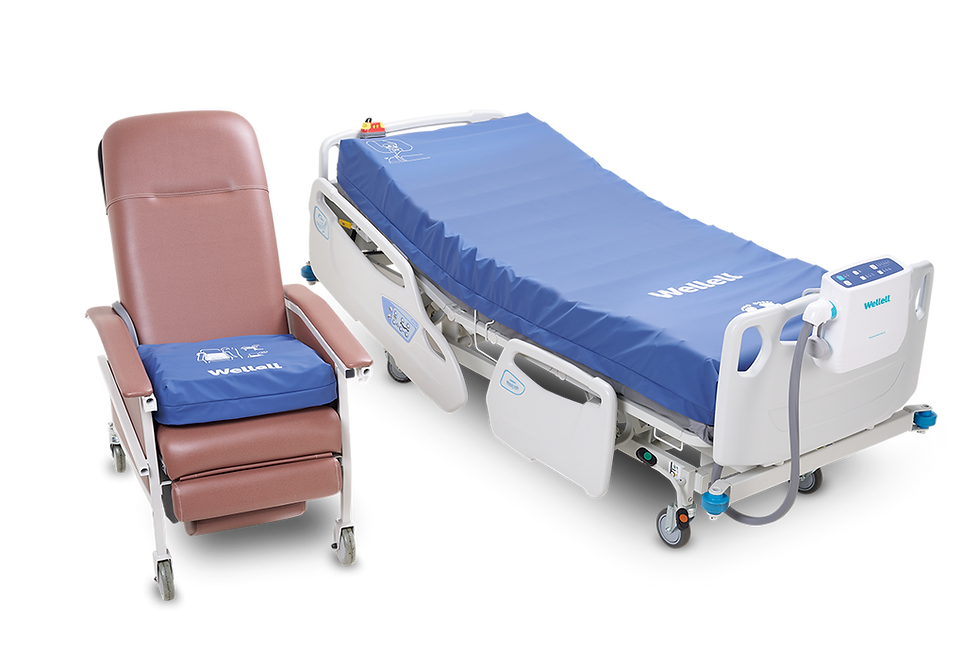


Explore Top Picks
Rent a Bed Today
Med-Mizer Deluxe Rotation Bed
The Deluxe Med-Mizer Rotation Bed transforms home care by gently rotating and reclining to help users get in and out of bed with ease — reducing fall risk, pressure injuries, and caregiver strain. It’s the ultimate blend of comfort, safety, and independence, making it the top choice for aging at home or post-hospital recovery. With a full Home Decor. Start Building Your Rotation Bed
Book a Virtual Consultation Demo Today with Our DME Specialist
What Makes the Deluxe Med-Mizer Rotation Bed Different and Worth It?
Unlike standard hospital or homecare beds that simply go up and down, the Deluxe Med-Mizer Rotation Bed offers 7 motorized High powered Functions with full-body rotation, reclining, and stand-assist functions — all designed to reduce falls, improve circulation, and promote safe, independent movement without relying fully on a caregiver. This means fewer injuries, less caregiver strain, and more dignity for the user. Start Building Your Rotation Bed
Book a Virtual Consultation Demo Today with Our DME Specialist
One Bed. Multiple Benefits. Long-Term Value.
Built with premium materials and advanced positioning technology, it replaces the need for multiple pieces of medical equipment, often eliminating the need for costly in-home aides or physical assistance for simple tasks like getting out of bed. While it costs more up front, it delivers unmatched long-term value in safety, mobility, and comfort — making it one of the smartest investments for aging in place, rehab, or long-term care at home. Start Building Your Rotation Bed
Book a Virtual Consultation Demo Today with Our DME Specialist
Deluxe Model Specs
This model has a full bed frame that resembles a regular home bed. With this model everything is accessible. Deck Height (low position): 12 3/4" Deck Height (high position): 28 3/4" Sleeping Surface: 36" or 42"W x 80"L Maximum Safe Working Load: 600lb Standard Options: NightLight, Battery Backup Optional Accessories: Mobility Bar, Foot Rails, Staff Controls, 4” bed Extender, Digital Scale (Deluxe), Trendeleburg/Reverse, Siderails.
Start Building Your Rotation Bed
Book a Virtual Consultation Demo Today with Our DME Specialist


Rotation Bed in Motion


Testimonials
Watch how the Med-Mizer ActiveCare Rotation Bed transforms daily care
Med-Mizer Standard Rotation Bed
The Standard Med-Mizer Rotation Bed transforms home care by gently rotating and reclining to help users get in and out of bed with ease — reducing fall risk, pressure injuries, and caregiver strain. It’s the ultimate blend of comfort, safety, and independence, making it the top choice for aging at home or post-hospital recovery. With Home Like design.
Book a Virtual Consultation Demo Today with Our DME Specialist
What Makes the Standard Med-Mizer Rotation Bed Different and Worth It?
Unlike standard hospital or homecare beds that simply go up and down, the Standard Med-Mizer Rotation Bed offers 7 motorized High powered Functions with full-body rotation, reclining, and stand-assist functions — all designed to reduce falls, improve circulation, and promote safe, independent movement without relying fully on a caregiver. This means fewer injuries, less caregiver strain, and more dignity for the user. See Cost Comparison Below
Book a Virtual Consultation Demo Today with Our DME Specialist
One Bed. Multiple Benefits. Long-Term Value.
Built with premium materials and advanced positioning technology, it replaces the need for multiple pieces of medical equipment, often eliminating the need for costly in-home aides or physical assistance for simple tasks like getting out of bed. While it costs more up front, it delivers unmatched long-term value in safety, mobility, and comfort — making it one of the smartest investments for aging in place, rehab, or long-term care at home. See Cost Comparison Below
Book a Virtual Consultation Demo Today with Our DME Specialist
Standard Model Specs
This model has a full bed frame that resembles a regular home bed. With this model everything is accessible. Deck Height (low position): 12 3/4" Deck Height (high position): 28 3/4" Sleeping Surface: 36" or 42"W x 80"L Maximum Safe Working Load: 600lb Standard Options: NightLight, Battery Backup Optional Accessories: Mobility Bar, Foot Rails, Staff Controls, 4” bed Extender, Digital Scale (Deluxe), Trendeleburg/Reverse, Siderails.
Book a Virtual Consultation Demo Today with Our DME Specialist


Cost Comparison: Standard Med-Mizer Rotation Bed vs. Traditional Homecare Approach
💼 Night time caregiver costs: Hiring overnight care can cost $200–$250 per night, adding up to $73,000–$91,250 per year. → The Deluxe Bed reduces or eliminates the need for this ongoing expense. 🛏️ Hospital bed rental costs: Standard electric bed rentals average $250/month, or $3,000/year. → Our bed includes advanced electric features — no need to rent. ♿ Extra mobility equipment: Buying or renting patient lifts, walkers, or sit-to-stand aids can cost $1,500–$3,500+. → The bed’s built-in rotation and stand-assist features reduce or replace these. 🏥 Hospital visits from fall injuries: A single fall-related ER visit costs $1,100, while inpatient stays average $18,670. → The bed’s design helps prevent falls — saving health and money. 💳 Total traditional cost (per year): Between $95,000 and $115,000, depending on care needs. → The Deluxe Med-Mizer Rotation Bed ranges from just $10,000–$25,000, with flexible financing available. For Extra Assistance Contact us Today 310-817-5373
Ai1 - All In One Expandable Low Bed
Expandable MED-SURGE bed platform designed specifically to accommodate a wide range of patient profiles. No longer will hospitals be at risk when larger patients are admitted and sent to a med-surg unit. The Ai1 has you covered in every setting. In Hospitals, Facilities and Homes


SonderCare Bed in Motion
Select Care Bed
The Med‑Mizer SelectCare Bed blends hospital‑grade functionality with residential style through features like powered height and positioning adjustments, Trendelenburg/reverse Trendelenburg, widths up to 42", and a 600 lb capacity — all designed for comfort, safety, and easier patient care. Its clinical contouring, under‑bed lighting, and wood finish options make it ideal for facilities or home settings seeking high quality without the institutional look.


RetractaBed
The Med‑Mizer RetractaBed lowers fall risk in long‑term and home care by featuring a retractable frame that pulls patients toward the bedside cabinet when the head‑section is raised, and by offering a low deck height (as low as 9"), dependable Hi‑Lo range (up to 25"), and strong load capacity (up to 500 lb). With Clinical‑Contour® features to reduce skin shear and optional safety controls, it’s built to deliver durable comfort, safety, and adaptability in any facility setting.


RetractaBed in Motion


EX8000
A Bed That Goes the Distance — and Everywhere in Between.Easy to operate and move as needed, the comfortwide ex8000 ™ bariatric low bed can support virtually any patient, any time.
Advanced Positioning
One button low-chair, Trendelenburg, and reverse Trendelenburg positioning.
Expand for Comfort
Bed expands to 48" wide with a single click, for easy added comfort and flexibility.
Low Bed Height®
9" be height reduces falls and makes bed ideal for most patients.


EX8000 in Motion
Deluxe T7036/42 LTC
The Century Long-Term Care Bed (Models T7036/T7042) is a fully electric, premium care bed designed specifically for Alzheimer’s residents and individuals with limited mobility. With quiet, synchronized DC motors, Trendelenburg/reverse positioning, and an ergonomic remote, this bed delivers top-tier comfort, safety, and independence. Features include a split-grid design for easy setup, 9" clearance for housekeeping access, locking swivel casters, and a sturdy steel frame — all built for reliable, long-term use in both home and facility care settings.
For Assistance Contact us 310-817-5373


T7036 in Motion

T7042 in Motion

T5200 LTC EXTRA WIDE
The Century T5200 Deluxe Bariatric Bed is a fully electric home care bed built for strength, comfort, and ease of use. With a 1,000 lb weight capacity (800 lb for 48" model), it features a lightweight yet durable aluminum alloy frame, 5-function remote, Trendelenburg positioning, and synchronized level control for maximum comfort. Heavy-duty 6" locking casters, a quiet AC motor system, and a 15-minute lithium battery backup ensure reliable performance, while scratch-resistant oak-finish panels add a touch of home. Available in 48", 54", and 60" widths, backed by a lifetime structural warranty.


Limitations
Limitations – Semi-Electric Hospital Bed
-
Manual height adjustment requires caregiver effort
-
Slower transfers – frequent raising/lowering is less efficient
-
Depends on electricity for head/foot functions (may need backup)
-
Mid-tier features – lacks full electric convenience
-
Limited insurance coverage in some cases due to manual controls
Basic Full Electric in Motion


